Filtered tap water vs bottled water: the real maths
Reverse osmosis versus mineral-water packs: the honest maths in euros, CO2 and microplastics for a Luxembourg family.
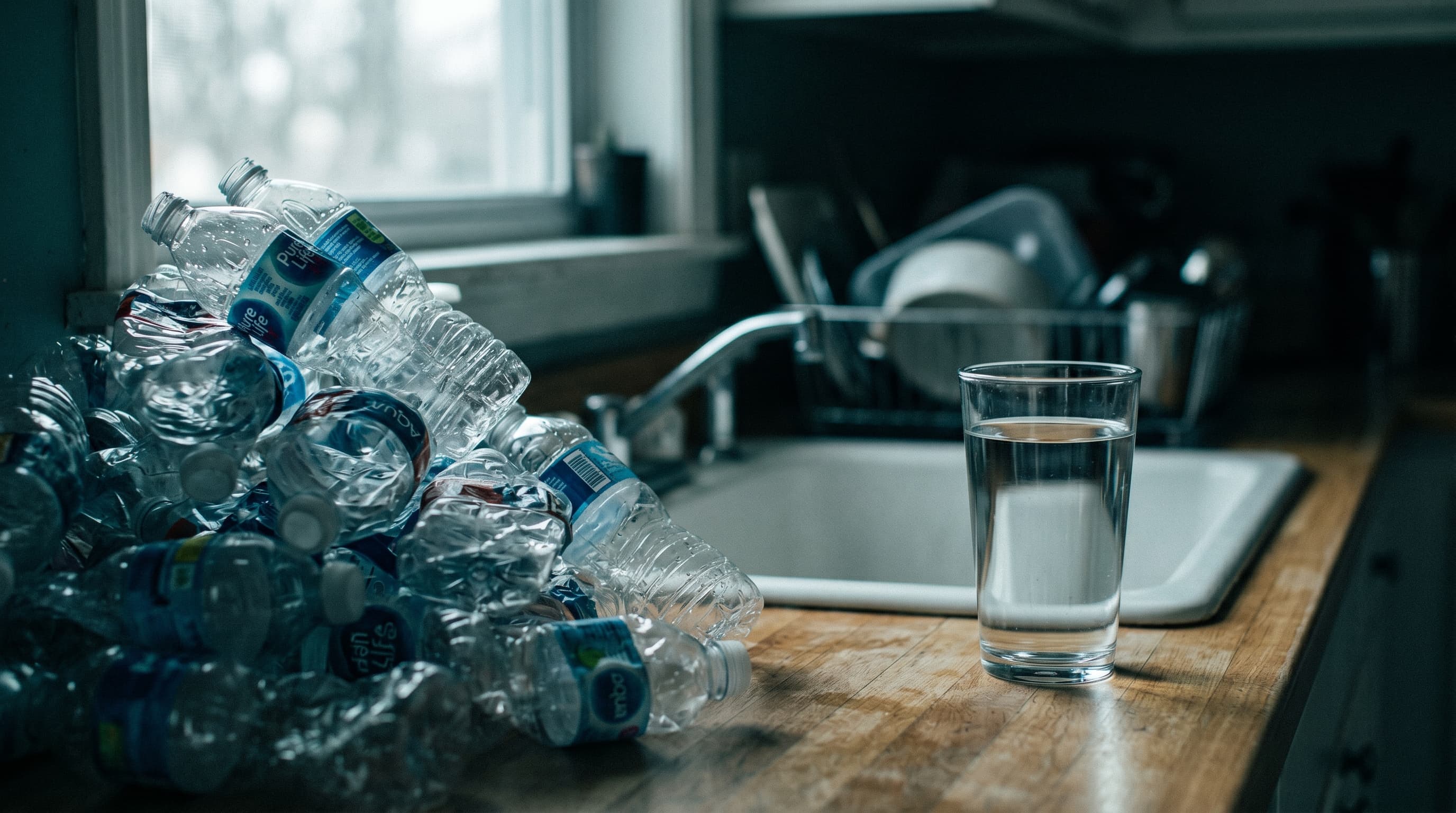
The real cost of bottled water
A family of four drinks around 1.5 L per person per day, or nearly 2,200 L a year. With bottled mineral water at €0.25 to €0.55/L depending on the brand, the bill quickly climbs to €500–1,200 a year, not counting hauling the packs and storing them. By contrast, tap water in Luxembourg costs around €0.005/L: even filtered by an RO system, the litre comes to a few cents.
Filtered tap water vs bottle: the criterion-by-criterion comparison
An RO system produces near-pure drinking water from the tap, removing nitrates, pesticides, PFAS, lead and chlorine. Against the bottle it wins on running cost, plastic and CO2, at the price of an upfront investment and light maintenance. This table sums up the match, criterion by criterion:
| Criterion | Filtered tap water | Bottle |
|---|---|---|
| Annual cost (family of 4) | €50–120 | €500–1,200 |
| Upfront investment | €350–1,200 | None |
| Microplastics | Near zero | Present |
| CO2 footprint | Very low | High (transport, plastic) |
| Plastic waste | None | Hundreds of bottles/year |
| Transport and storage | None | Packs to carry |
| Filtration quality | Nitrates, PFAS, lead removed | Varies by brand |
Switching to filtered tap water in Luxembourg
Before investing, check your water quality with our free diagnostic: it gives your commune's hardness and the parameters to watch. If you live in a farming area or have an infant, the under-sink RO system is the go-to solution for drinking water. For a quote tailored to your commune, our partners at osmoseur.lu install and maintain the system across the Grand Duchy; for limescale throughout the house, adoucisseur-eau.lu steps in alongside.
Frequently asked questions
Is filtered tap water really cheaper than the bottle?
Yes, by far. A family of four spends €500 to €1,200 a year on bottles, versus €50 to €120 for RO-filtered tap water. The upfront investment pays back in around a year.
Does an RO system remove microplastics?
Yes. The reverse-osmosis membrane, with pores around 0.0001 micron, retains nearly all micro- and nanoplastic particles, far finer than what a jug can filter.
Is bottled water better quality than tap water?
Not necessarily. Luxembourg tap water is tightly monitored, and RO-filtered it is free of nitrates, pesticides, PFAS and lead. Bottled-water quality, on the other hand, varies by brand.
How many plastic bottles do you avoid with an RO system?
For a family of four, you typically avoid 1,000 to 1,500 one-and-a-half-litre bottles a year, or several thousand over the system's lifetime.
Does the RO system waste so much water it cancels the green benefit?
No. Reverse osmosis sends some water to the drain, but recent pump-assisted models have sharply reduced this ratio. The balance stays very favourable against making and transporting bottles.