What does reverse osmosis really filter? Nitrates, pesticides, PFAS, lead
A detailed list of what reverse osmosis removes — with real reduction rates — and the few things it lets through.
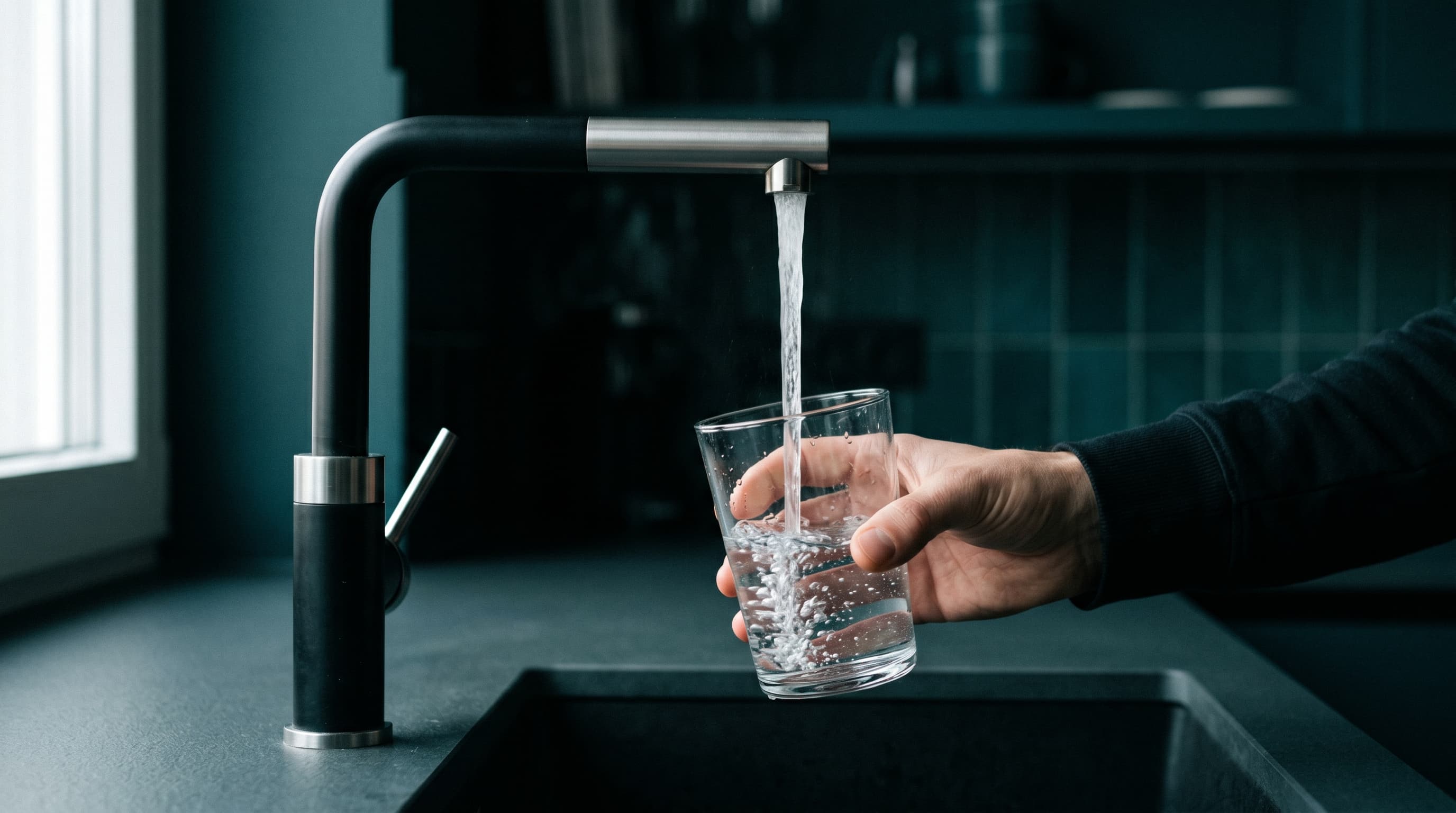
A physical barrier, not a chemical one
Unlike a simple cartridge, an RO system filters physically: the membrane lets the water molecule through but blocks anything larger, down to dissolved ions. That is what lets it retain pollutants no filter jug can catch.
What it removes, and at what rate
Here are the main contaminants retained by reverse osmosis, with the reduction rates typically seen on a well-maintained domestic system:
| Contaminant | Removal rate | Good to know |
|---|---|---|
| Nitrates | 90–97% | Farming areas, water for infants |
| Pesticides & herbicides | > 95% | Dissolved molecules blocked by the membrane |
| PFAS (forever chemicals) | > 95% | Covered by the EU 2026 limit |
| Lead & heavy metals | > 97% | Old pipes, solder joints |
| Chlorine, tastes, odours | ≈ 100% | Thanks to the activated-carbon pre-filter |
| Limescale (Ca / Mg) | Strongly reduced | Drinking water only |
| Bacteria & viruses | Blocked | Too large to cross the membrane |
What it lets through, its limits
A few dissolved gases (such as CO₂) can pass, with no health impact. Above all, by removing contaminants, osmosis also removes useful minerals (calcium, magnesium): an overly pure water with a flat taste, corrected with a remineralisation cartridge. Finally, the system treats drinking water at the point of use: it does not protect the house from limescale, which remains the softener's job.
An RO system purifies drinking water under the sink: it does not protect the house from limescale. That is the softener's job — the two are complementary, not competitors.
The full chain: pre-filters + membrane + remineralisation
A good RO system chains several stages: sediment and carbon pre-filters (which protect the membrane and remove chlorine), the reverse-osmosis membrane (the core of the system), then a post-filter and remineralisation. It is this combination that guarantees water that is both safe and pleasant to drink. Our partners at osmoseur.lu size the system to your water.
Frequently asked questions
Does reverse osmosis remove nitrates?
Yes — reverse osmosis retains 90 to 97% of nitrates, making it the go-to home solution in farming areas and for preparing water for infants.
Does an RO system filter PFAS?
Yes, by over 95%. Along with specialised activated carbon, it is one of the few technologies effective against the forever chemicals covered by the EU limit in force since 2026.
Is osmosis water too pure to be healthy?
Osmosis also removes useful minerals. Most RO systems add a remineralisation cartridge that restores calcium and magnesium and brings back taste.
Does an RO system replace a water softener?
No. The RO system treats drinking water under the sink; the softener treats limescale throughout the house. They meet two different needs and complement each other.
Does reverse osmosis remove limescale?
In drinking water it strongly reduces calcium and magnesium. But it does not act on hot water or pipes: limescale in the water heater remains the softener's domain.