Limescale in the water heater: +30% on your bill
Why scale attacks the water heater first, what it really costs in energy, and how to prevent it for good.
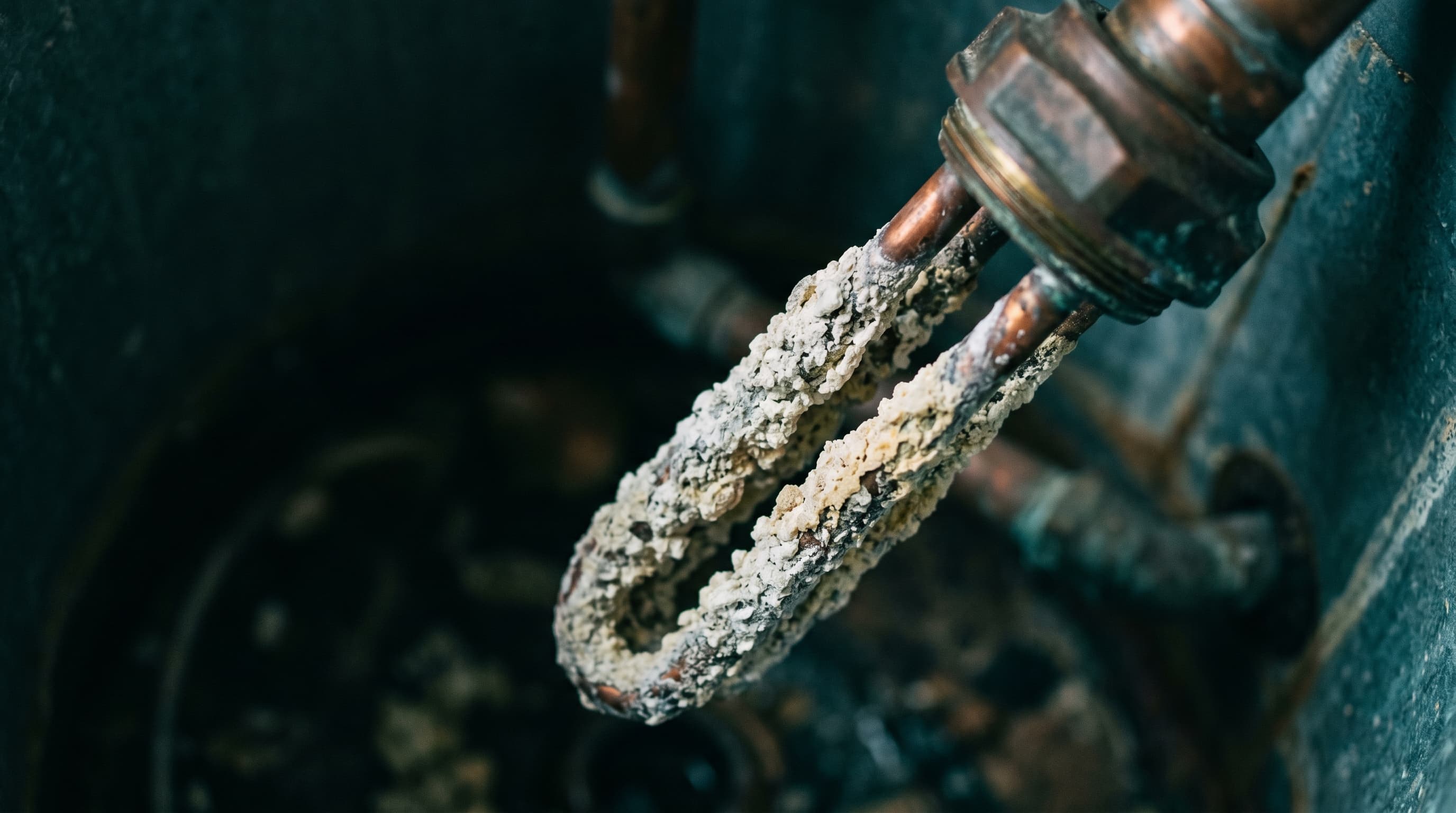
Why the water heater is the first victim
Calcium carbonate precipitates faster the hotter the water is. The water heater and boiler, where water reaches 55–65 °C, are therefore the first places scale settles — directly on the element or heat exchanger, exactly where it does the most damage.
Above 60 °C, scale formation accelerates sharply: that is why the element, the hottest point in the circuit, scales up first.
The energy surcharge, in figures
Scale is an insulator: it forces the element to heat longer for the same result. About 1 mm of thickness adds 7% consumption, and 5 mm can reach 30%. On a hot-water bill of several hundred euros a year, that quickly means hundreds of euros wasted, not counting the risk of premature element failure.
| Scale thickness | Extra consumption | Impact |
|---|---|---|
| 1 mm | approx. +7% | Slight but real |
| 3 mm | approx. +20% | Clear on the bill |
| 5 mm | approx. +30% | Failure risk |
The signs of a scaled-up tank
Cracking or kettle-like noises when heating, water that takes longer to heat or cools faster, electricity use creeping up for no reason, and in advanced cases a leak at the safety group. If your water exceeds 25°fH, these symptoms often appear within just a few years.
How to protect it for good
Descaling a tank afterwards is possible but heavy and temporary. The only effective preventive protection is to treat the water at the inlet with a softener: with no calcium or magnesium, there is no more deposit on the element. Check your municipality's hardness with our free diagnostic to find out whether your water heater is exposed.
Frequently asked questions
At what hardness is my water heater at risk?
Above 25°fH, scaling becomes rapid and symptoms often appear within a few years. Between 15 and 25°fH the risk exists but is more gradual.
Does 1 mm of scale really push the bill up by 7%?
Yes. Scale is a thermal insulator: the element has to heat longer for the same volume of hot water. The order of magnitude of 7% per millimetre is widely cited by heating professionals.
Is descaling my tank enough?
Descaling restores efficiency, but it is curative and temporary: without water treatment the scale forms again. Only a softener upstream prevents the deposit for good.
Does lowering the heater temperature limit scale?
It slows precipitation, but dropping below 50 °C encourages legionella growth. So it is not a recommended way to fight limescale.
Does a softener also protect the boiler?
Yes. Any appliance that heats water (boiler, heat exchanger, dishwasher) benefits from the removal of calcium and magnesium at the home's inlet.