How limescale destroys your appliances
Washing machine, dishwasher, kettle, coffee machine, water heater: what scale really costs your appliances, in overconsumption, breakdowns and lost lifespan.
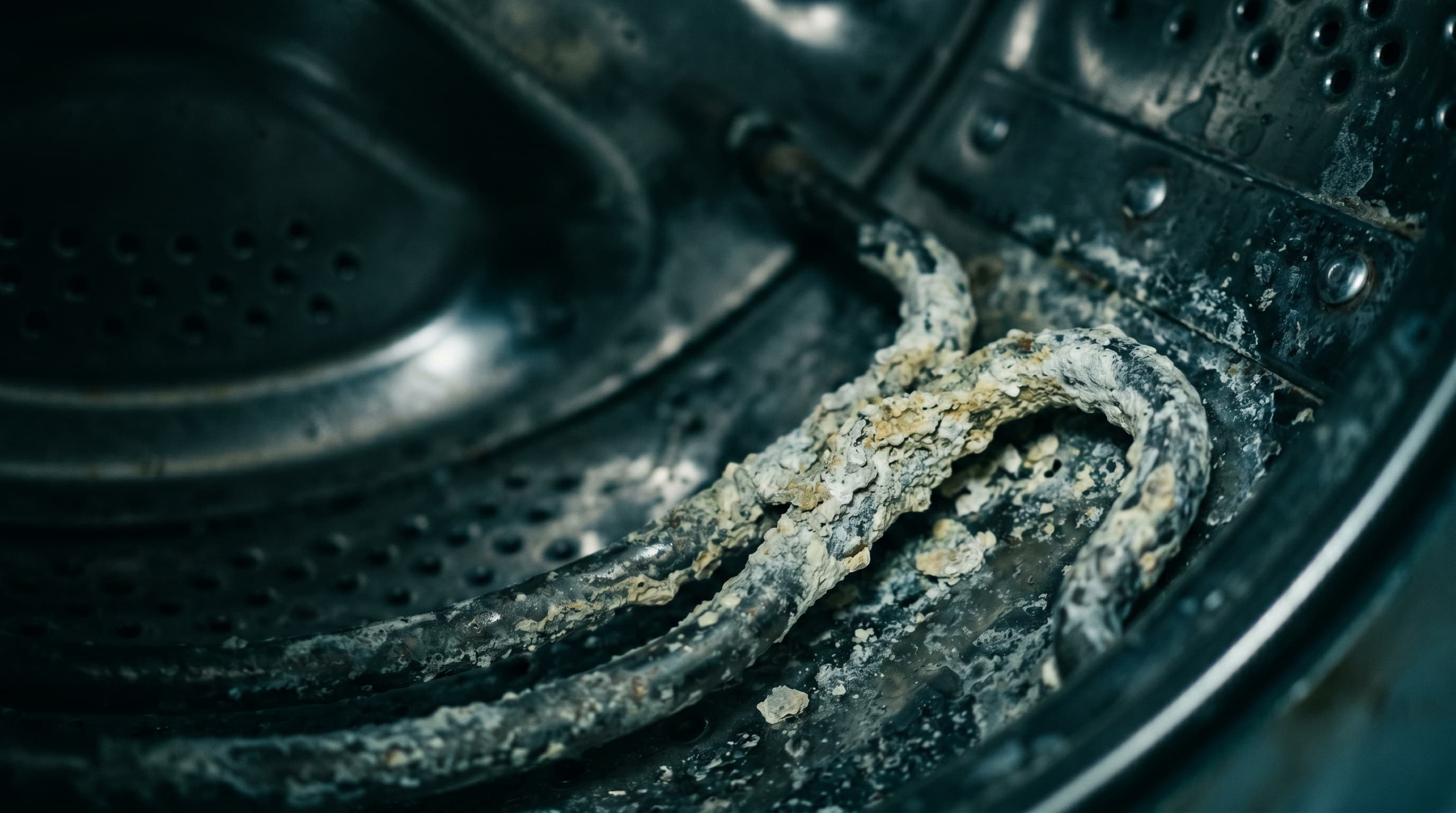
Why limescale attacks appliances first
Limescale (calcium carbonate) precipitates as soon as hard water is heated: the higher the temperature, the faster scale forms. Yet your appliances are precisely the ones that heat water, in repeated cycles and at high temperature. Heating elements, heat exchangers, solenoid valves and hoses become the first targets, long before taps or visible surfaces.
Limescale starts precipitating from 60 °C. A dishwasher heating to 65–70 °C several times a day in hard water therefore scales up far faster than a simple tap.
Appliance by appliance: what scale costs
Not all heating appliances age at the same rate against limescale. This table sums up, for each one, the main effect of scale and the order of magnitude of lifespan lost in hard water compared with softened water.
| Appliance | Effect of limescale | Reduced lifespan |
|---|---|---|
| Washing machine | Scaled element, rough laundry, long cycles | 10–12 years instead of 15 |
| Dishwasher | Clogged nozzles, cloudy dishes, heating failure | 7–8 years instead of 12 |
| Kettle | White deposits, overconsumption, altered taste | 2–3 years instead of 5 |
| Coffee machine | Blocked circuit, low flow, breakdown | 3–4 years instead of 8 |
| Water heater | Insulated element, overheating, efficiency loss | 8–10 years instead of 15 |
Descale or treat at the source?
Descaling with vinegar or citric acid is curative: useful on a kettle or coffee machine, but ineffective as prevention and impossible on the internal parts of a washing machine. The only way to durably protect all your appliances is to remove limescale before it enters them, with a softener installed on the water inlet. To find out whether your municipality justifies one, run our free diagnostic; for a tailored quote, our partners adoucisseur-eau.lu and osmoseur.lu operate throughout Luxembourg.
- A softener stops scale before it reaches the appliances
- Washing machine, dishwasher and water heater last far longer
- Less electrical overconsumption and fewer premature breakdowns
- Less detergent, regeneration salt and rinse aid
- One-off descaling never protects the internal circuits
- Vinegar is curative, never preventive
- A softener requires an upfront investment and some maintenance
- Little use if your water is already soft (< 15°fH)
Frequently asked questions
Does limescale really damage the washing machine and dishwasher?
Yes. Scale builds up on the heating element, nozzles and solenoid valves, lengthening cycles, degrading washing and causing breakdowns. In untreated hard water, the lifespan of these appliances can drop by 30 to 50%.
Why do the kettle and coffee machine scale up so fast?
Because they heat small volumes of water very frequently and at high temperature, which precipitates limescale quickly. In hard water, white deposits appear within weeks and cut their lifespan to 2 to 4 years.
Does dishwasher salt protect against limescale?
It only softens the dishwasher's own water for rinsing and reduces marks, but it protects neither the rest of the house nor the other appliances. Only a softener treats all the water at the inlet.
Is regular descaling enough to protect my appliances?
Descaling helps for accessible devices like a kettle or coffee machine, but it stays curative and cannot reach the internal circuits of a washing machine or water heater. Lasting protection means removing limescale at the source.
From what hardness should you protect appliances?
Above 20°fH, appliance scaling accelerates markedly and a softener becomes cost-effective. Between 15 and 20°fH it's a comfort choice; below 15°fH the water is already soft.