Water hardness in Luxembourg
Understanding the measurement in French degrees (°fH), Luxembourg's standards and the impact of limescale on your home.
What is water hardness?
Water hardness corresponds to the concentration of calcium (Ca²⁺) and magnesium (Mg²⁺) ions. The more calcareous rock the water has passed through before reaching the tap, the harder it is. In Luxembourg, the predominantly calcareous subsoil (particularly in the Gutland) produces water that is often moderately hard to hard, whereas the Oesling regions in the north yield softer water.
The French degrees scale (°fH)
Luxembourg mainly uses the French degree (°fH). 1°fH = 10 mg/L of calcium carbonate. The official scale distinguishes: very soft (0–7°fH), soft (7–15°fH), moderately hard (15–25°fH), hard (25–35°fH) and very hard (>35°fH). In Germany and the Grand Duchy, the German degree (°dH) is also used: 1°dH = 1.79°fH.
| Class | °fH | °dH (approx.) | mg/L CaCO₃ |
|---|---|---|---|
| Very soft | 0–7 | 0–4 | 0–70 |
| Soft | 7–15 | 4–8 | 70–150 |
| Moderately hard | 15–25 | 8–14 | 150–250 |
| Hard | 25–35 | 14–20 | 250–350 |
| Very hard | >35 | >20 | >350 |
Why it matters for your home
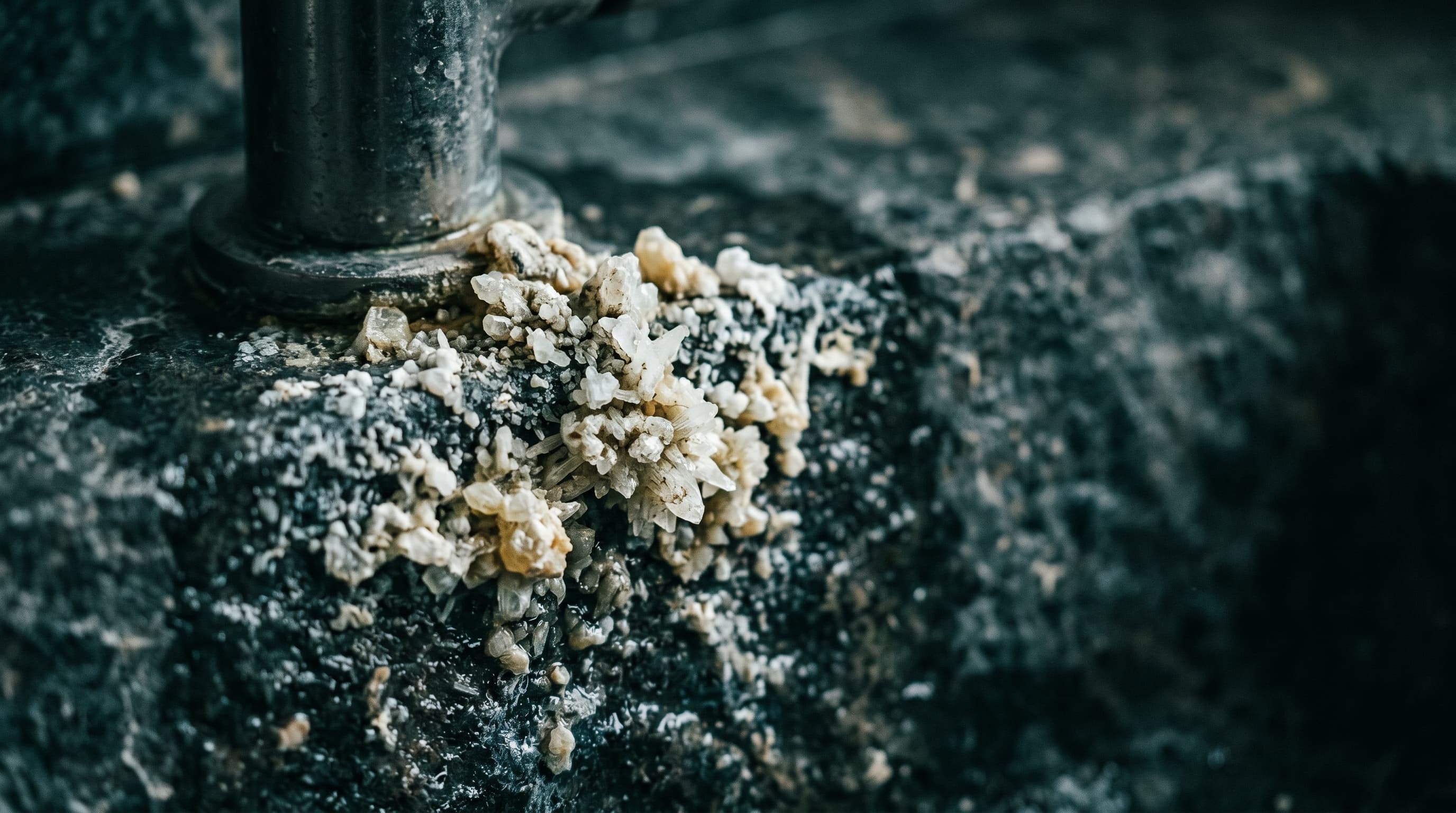
Above 20°fH, limescale builds up in pipes, reduces flow, insulates water-heater elements (up to 30% additional consumption for 5 mm of scale), stains taps, stiffens laundry and dries out the skin. Over the long term, the lifespan of household appliances also drops. A water softener removes these ions in favour of sodium, neutralising the problem at the source.
A limescale layer of just 1 mm on a heating element already raises energy consumption by around 7%.
The situation in Luxembourg
Across 106 distribution zones analysed, more than 75% deliver water classified as soft to moderately hard. The municipalities most exposed to limescale are concentrated in the south and east of the country. Our interactive map lets you find out exactly how hard the water is in your municipality.
Frequently asked questions
What is the average water hardness in Luxembourg?
It usually sits between 15 and 25 °fH, meaning moderately hard water. The Gutland in the south is more calcareous than the Oesling in the north.
How do I convert °fH to °dH?
Divide the °fH value by 1.79. For example, 25 °fH corresponds to roughly 14 °dH.
At what hardness is a water softener worthwhile?
Above about 20 °fH, limescale deposits become significant on pipes and appliances. A softener is then fully justified.
How do I find out the exact hardness at my address?
Check your water supplier's data sheet or our interactive map by municipality. A home test kit also gives a reliable indicative value.
Is hard water harmful to health?
No. Calcium and magnesium pose no health risk and even contribute to mineral intake. The problem with hard water is purely domestic and material.