Limescale and scale: effects on your home
How scale forms, where it builds up first, and how much it costs you each year.
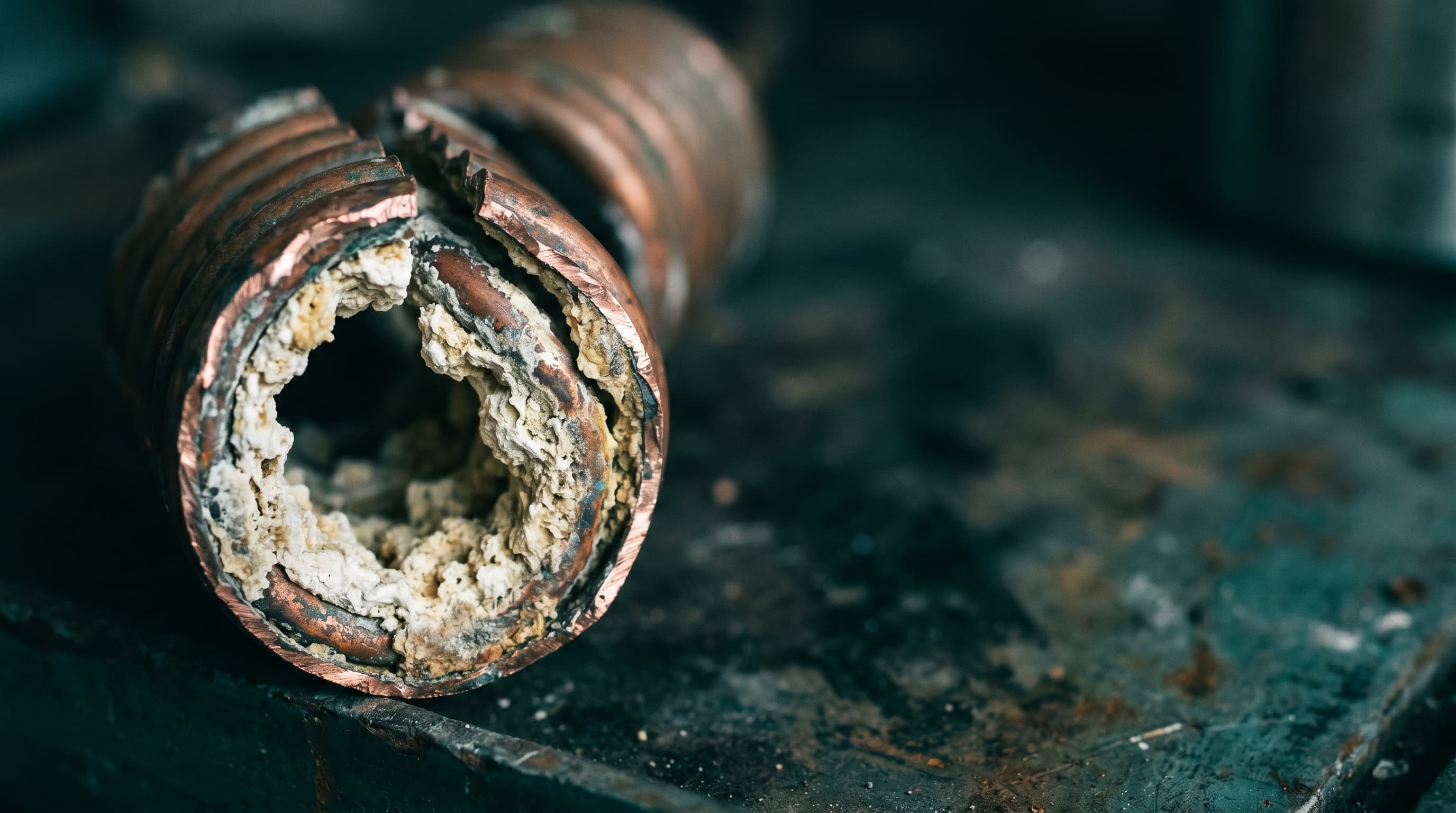
What exactly is limescale?
Limescale (calcium carbonate, CaCO₃) precipitates when hard water is heated or evaporated. The higher the temperature, the faster the precipitation. That is why the water heater and the boiler are the first victims of scale.
Limescale starts precipitating from 60°C. Setting the water heater to 55-58°C slows scaling without encouraging legionella.
The real cost of limescale
On a water heater, 1 mm of scale = +7% electricity consumption. 5 mm = +30%. Over 10 years, on an annual hot-water bill of €800, that is easily €1,500 to €2,500 thrown away on wasted heating. Add the early replacements (water heater, dishwasher, washing machine), the taps to be replaced and the descaling — the bill quickly climbs to €5,000 over 15 years.
| Scale thickness | Extra consumption | Effect |
|---|---|---|
| 1 mm | +7% | Efficiency loss |
| 3 mm | +18% | Slower heating |
| 5 mm | +30% | Element overheating |
| 7 mm and more | +40% | Early failure |
Where limescale strikes first
The water heater and boiler first (heating elements, exchangers). Then the washing machine, dishwasher, thermostatic mixer taps and tapware. On laundry and skin, limescale neutralises part of the soap, forces you to use more product, and stiffens textile fibres. On surfaces (shower, glass), it leaves white marks that are hard to clean.
Solutions
Resin-based water softener (gold standard): removes 99% of limescale right at the water inlet, protecting the whole house. Magnetic or polyphosphate anti-scale devices: limited effect, not scientifically recognised. White vinegar: a remedy for surfaces, never preventive. For complete protection, the water softener remains the benchmark solution.
Frequently asked questions
At what hardness does limescale become a problem?
Above 15°fH, deposits become visible and costly. Above 25°fH, scaling of appliances accelerates markedly and treatment becomes worthwhile.
Is white vinegar enough against scale?
Vinegar dissolves limescale already formed on accessible surfaces, but it prevents nothing upstream. It is a remedy, never a preventive measure.
Do magnetic anti-scale devices work?
Their effectiveness is not scientifically proven and they remove no calcium from the water. Only a resin-based softener genuinely removes hardness.
How long before scale damages a water heater?
With untreated hard water, a layer several millimetres thick forms within a few years, shortening the appliance's lifespan and increasing the electricity bill.
Does a softener remove limescale completely?
Properly set, it removes up to 99% of the hardness and stops new scale from forming. Limescale already deposited then dissolves gradually.