Salt vs salt-free softeners: what are anti-scale devices really worth?
Ion exchange, magnet, electronic, CO₂, polyphosphates: only the salt softener removes hardness. The honest take on what salt-free solutions do — and don't.
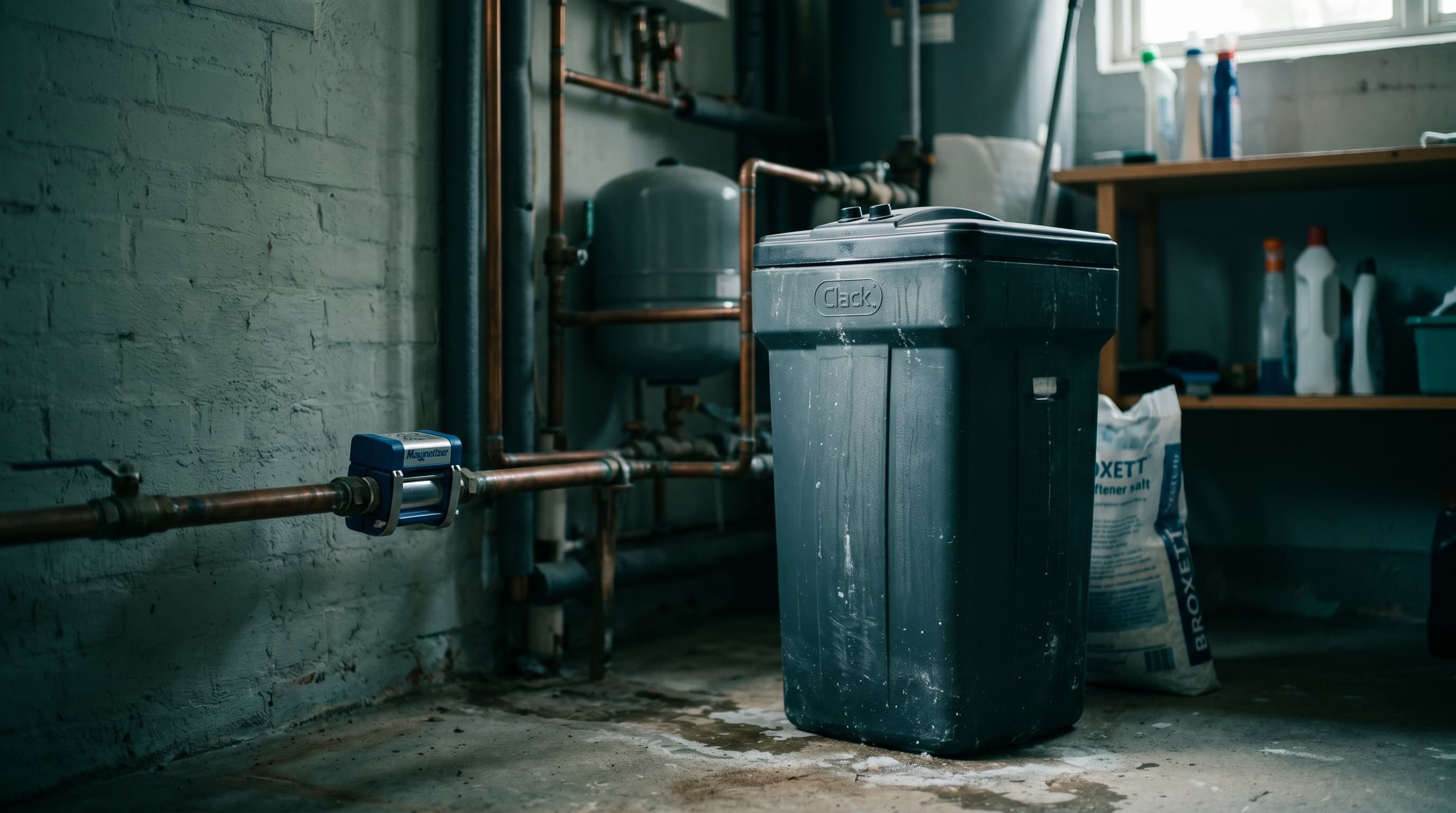
Softening is not anti-scale: the distinction that changes everything
Softening water means removing the calcium and magnesium that make up hardness — a measurable change, in °fH. Anti-scale, by contrast, refers to any process that prevents limescale from building up without removing it: the calcium stays in the water but precipitates in a form that sticks less to surfaces. This nuance explains why a magnetic device and a salt softener are not in the same league.
The technologies head to head
Here are the five approaches you'll come across, sorted by their principle and their real effectiveness on hardness and on scale build-up. Only the first softens the water in the true sense; the others at best limit scale deposition.
| Technology | Principle | Real effectiveness | Maintenance |
|---|---|---|---|
| Ion exchange (salt) | Resins: Ca/Mg replaced by sodium | Removes hardness (up to 99%) | Salt + annual service |
| Magnetic / electromagnetic | Field meant to alter crystallisation | No hardness drop, anti-deposit effect uncertain | Almost none |
| Electronic (pulses) | Electric signal on the pipe | No softening, anti-scale effect variable | Almost none |
| CO₂ injection | Slightly acidifies the water | Hardness unchanged, scale less adherent | Gas refill |
| Polyphosphates | Sequester calcium in suspension | No softening, delays deposition | Cartridge refill |
Pros and limits of salt-free
Salt-free solutions appeal through simplicity: no salt tank, no added sodium, no water discharge at regeneration, and often a lower entry price. But their real effectiveness varies widely and is poorly backed by independent measurement: they do not lower hardness, so your skin, laundry and soap usage do not change.
- No salt or added sodium in the water
- No water discharge or regeneration
- Compact install, often without a plumber
- Purchase and upkeep usually low-cost
- No known health risk
- Relevant if you only want to slow deposition
- Does not lower hardness (still the same °fH)
- Anti-deposit effect variable and barely proven
- Skin, laundry and soap unchanged
- Effect often limited to moving water
- Polyphosphates and CO₂ need refills
- No substitute for a softener in very hard water
Which to choose for your water in Luxembourg
Above 25°fH with an electric water heater, only ion exchange truly protects the whole house and improves day-to-day comfort. A salt-free anti-scale device can suffice for moderately hard water, a rental, or a top-up on a single appliance. First check your municipality's hardness with our free diagnostic, then compare quotes from our partners adoucisseur-eau.lu; for drinking water, that's osmoseur.lu.
Let's be clear: no magnet lowers hardness. If a seller promises softened water without salt that is measurable in °fH, it is false. Salt-free sometimes limits scale build-up — it never softens.
Frequently asked questions
Does a magnetic softener really soften the water?
No. A magnetic or electromagnetic device removes neither calcium nor magnesium: hardness stays identical in °fH. At best it alters crystallisation to limit deposits on surfaces, with variable effectiveness barely proven by independent measurement.
What is the difference between softening and anti-scale?
Softening physically removes calcium and magnesium (hardness drops, measurable in °fH): that is the job of salt ion exchange. An anti-scale method leaves these minerals in the water but tries to prevent their build-up. Only softening changes how the water feels on skin and laundry.
Does salt-free work on the water heater?
The effect of salt-free solutions fades on standing, hot water — exactly where scale forms most. On an electric water heater in very hard water, only the salt softener durably prevents deposits on the heating element.
Are CO₂ and polyphosphates softeners?
No. CO₂ injection slightly acidifies the water so scale adheres less, and polyphosphates sequester calcium in suspension. In both cases hardness stays unchanged: they are anti-scale methods, not softeners.
When is salt-free genuinely enough?
For moderately hard water, a rented home, or a top-up on a single appliance, a salt-free solution can limit deposition at low cost. Above 25°fH or to gain comfort (skin, laundry, less soap), the salt softener remains the only effective answer.